

The 90% Availability Paradox: Why Healthy Mining Equipment Can Still Underperform


The Asset Utilization Gap: Moving Past Vanity Metrics in Mining Operations
The 90% availability paradox highlights a critical disconnect in mining operations: high asset readiness does not automatically translate to optimal production throughput. While a 90% mechanical availability rating indicates strong maintenance performance, it frequently masks severe operational inefficiencies where asset capacity is lost to non-productive utilization.
To drive sustainable profitability, operators must shift focus from pure asset readiness to comprehensive asset optimization by analyzing the distinct phases of the equipment lifecycle: availability, utilization, and operational effectiveness.
Deconstructing the Asset Utilization Gap
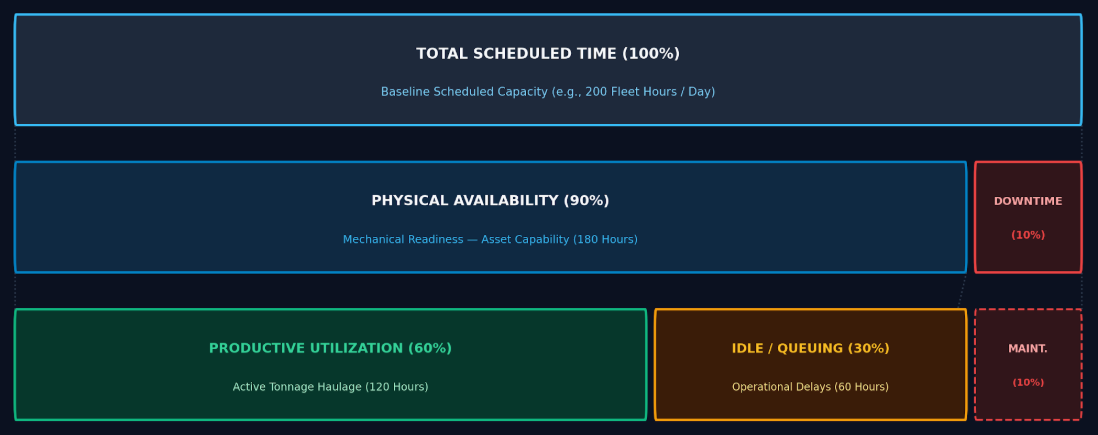
Mechanical availability indicates the proportion of scheduled time that equipment is available for operation. While it provides an important measure of equipment reliability, it does not reveal how effectively that available time is used. Like in the case a machine enters active shift rotation. A haul truck may maintain 100% mechanical readiness while spending significant portions of a shift idling at a loader, queuing at the primary crusher, or stalled by dispatch bottlenecks.
Depending on the time-classification methodology, these activities may legitimately form part of reported operating time. However, when they are not distinguished from productive work, the reporting provides an incomplete picture of how equipment capacity is being used.
The Global Mining Guidelines Group (GMG) time-classification model, provides a framework for making these distinctions. By separating available, operating, working and productive time, mining operators can understand not only whether equipment is ready for use, but how that availability translates into productive activity.
Quantifying the Operational Variance
To illustrate the capacity gap, consider a baseline fleet deployment of 10 haul trucks scheduled for 20 operating hours per day, yielding a gross capacity of 200 scheduled hours.
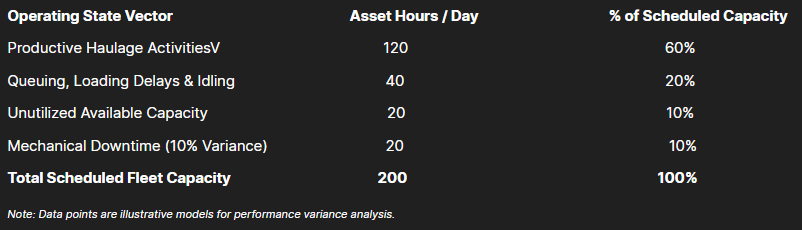
This structural breakdown demonstrates that despite maintaining a healthy 90% availability profile, the fleet delivers true productive output during only 60% of the scheduled timeline. Some waiting periods and supporting activities are inherent to mining operations. Distinguishing these from avoidable delays allows operators to identify where productive capacity may be recovered.
Granular Idle-Time Diagnostics via Telemetry
Treating idle time as a monolithic metric prevents targeted operational adjustments. A truck idling due to an upstream crusher failure represents a systematic processing constraint, whereas a truck idling due to improper shovel matching indicates a fleet optimization issue.
Resolving these inefficiencies requires high-fidelity machine telemetry. By cross-referencing real-time engine states, payload signals, and geospatial positioning, operators can convert raw asset data into contextualized operational intelligence. The strategic objective is not the arbitrary elimination of idle states, but rather the systematic eradication of non-value-adding fuel burn and component wear.
Standardizing Mixed-Fleet Intelligence
Implementing an enterprise-grade optimization strategy requires standardized machine-state data across the entire organization. This presents a challenge in mixed-fleet environments, where different original equipment manufacturers (OEMs) use proprietary data protocols and conflicting status definitions.
Once these disparate data streams are normalized into a unified model, management can run comparative analyses across shifts, operators, and equipment classes. This systemic visibility allows operators to isolate underperforming variables, eliminate hidden capacity losses, and establish highly accurate operational benchmarks across the entire lifecycle of the asset.
Optimizing Beyond the Availability Dashboard
Maximizing mining asset profitability requires looking past traditional maintenance dashboards. While high availability confirms asset readiness, true operational excellence is determined by how effectively that readiness is converted into productive output.
For mixed-fleet operators, answering these questions starts with consistent equipment data. TALPA's OEM-independent industrial intelligence platform brings machine operating information from different manufacturers into a common analytical environment, making utilisation patterns, idle time and equipment performance easier to examine across the fleet.
A fleet reporting 90% availability may have a reliability problem largely under control. Whether it has a productivity problem is a separate question. The answer lies in understanding what happens during the hours when equipment is available but not producing.
Ready to bridge the gap between availability and profitability. Discover how to systematically uncover and reclaim lost operating hours across your mixed fleet.
Subscribe to our newsletter today
Lorem ipsum dolor sit amet consectetur nulla augue arcu pellentesque eget ut libero aliquet ut nibh.