

A dashboard doesn’t reduce downtime. A decision system does.

Unexpected downtime is the prototype case of “undesired machine behavior”: it’s expensive, it escalates fast, and it often brings collateral damage—missed deadlines, contractual penalties, safety risk, and reputational impact.
Most fleet operators and service organizations already know this. The more interesting question is: why does it still take so long to get machines back to productive operation—despite telemetry, cloud dashboards, and digital tools everywhere? The short answer: because most digital setups optimize visibility, not decisions.
The wrench-time paradox
When you look at real “machine back up” workflows, the surprising part is how little time is spent on the actual fix. What dominates is everything around it:
- waiting until someone notices,
- handoffs and coordination,
- travel and site access,
- diagnosing without enough context,
- ordering parts too late (or ordering the wrong ones),
- rework because the first attempt didn’t fully resolve the issue.
In other words: the repair action can be short, but the time to recovery is not. So if we want to reduce downtime, we need to measure the right things.
The three metrics that matter: MTTD, MTTA, MTTR
For operational uptime, these three metrics tell the story better than any dashboard screenshot:
MTTD (Mean Time To Detect)
How long it takes from “something is wrong” to “we reliably detect it.”
MTTA (Mean Time To Acknowledge)
How long it takes from “we detected it” to “a responsible person/team explicitly owns it.”
MTTR (Mean Time To Repair/Restore)
How long it takes until the machine is back to productive operation.
If you want a single mental model: Detection → Notification/Routing → Action, and each step has a measurable latency contribution.
Why dashboards plateau
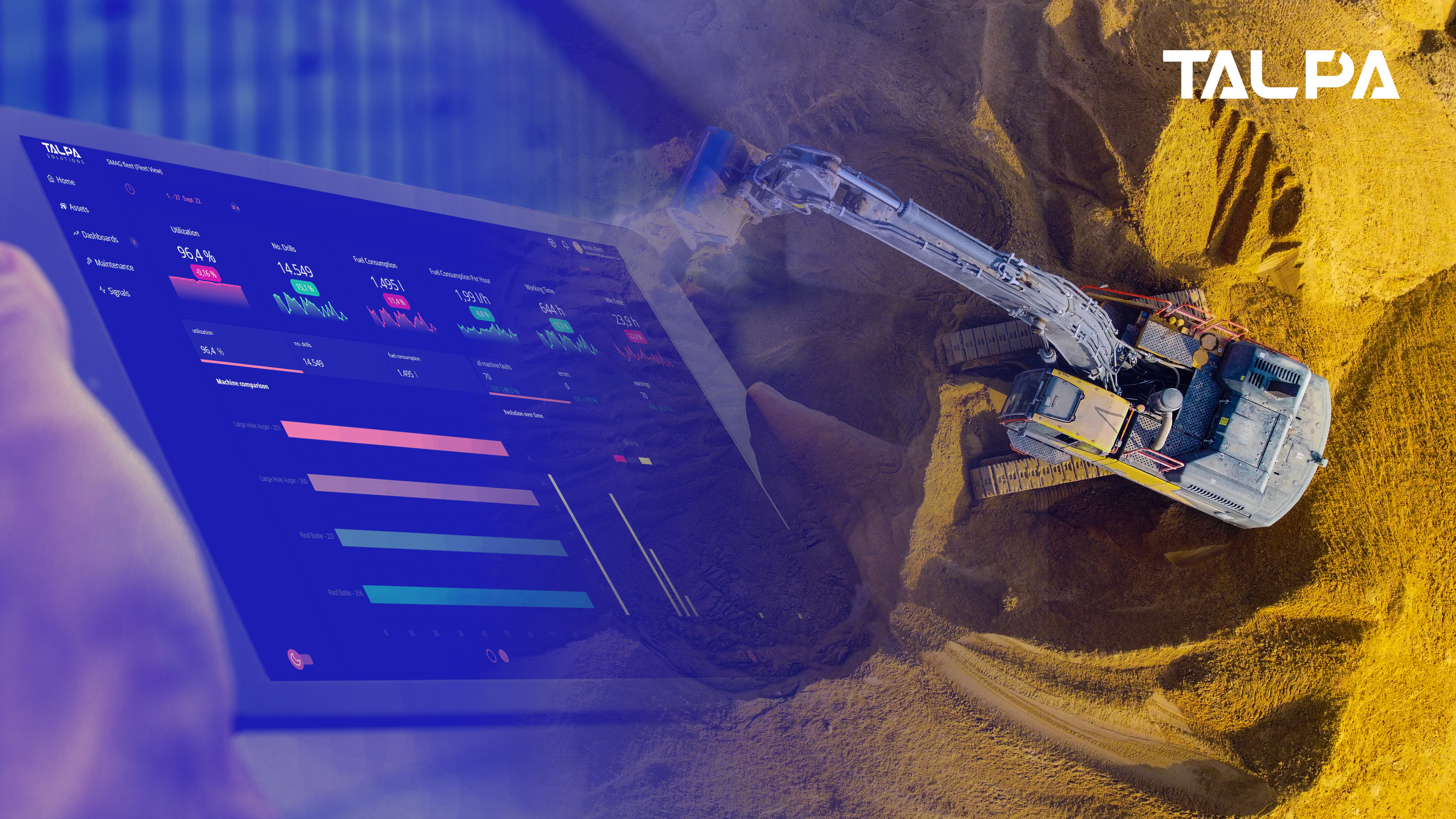
Telemetry in the cloud is valuable. Dashboards are valuable. But dashboards are fundamentally a pull system:
- someone has to remember to check,
- interpret the signals correctly,
- decide severity vs. other concurrent issues,
- coordinate across multiple tools (tickets, calls, chats, ERP/parts ordering, dispatch),
- follow through until the machine is productive again.
Dashboards improve visibility. They often do not reliably compress:
- MTTA (ownership still bounces around)
- and the “coordination” component of MTTR (parts + dispatch + approvals + workflow fragmentation).
That’s why many organizations feel “more data” but not “faster recovery.”
What a decision system is (and what it isn’t)
A decision system isn’t “more analytics.” A decision system couples detection with proactive routing and executable next steps—then measures the loop so it improves. In practice, it has a few core building blocks:
- Detection (ideally predictive, not just reactive)
- Routing and escalation (MTTA killer)
- A context pack (diagnosis accelerator)
- Action triggers (MTTR killer)
- Closed-loop learning
This is how you go from “we saw it” to “we resolve it faster next time.”
A simple “latency budget” view of MTTR
A practical way to think about MTTR is a latency budget: MTTR = waiting + awareness + ownership + diagnosis + parts + dispatch + repair + verification.
Dashboards mainly help “awareness” if people look. Decision systems attack the big buckets—ownership, coordination, and time-to-action—which often dominate.
What we see in practice at talpasolutions GmbH
Here’s a concrete example of actual impact:
- Once machine data is transmitted to the cloud, our system typically detects a breakdown within 5–10 minutes (that’s our MTTD, measured from cloud ingest).
- In contrast, common reporting chains can take several hours up to a day before the right party even has a clear signal and ownership (that’s MTTA ballooning through human relays).
- And the overall MTTR (until the machine is back to productive operation) is often 2–5 days in real operations—so shaving hours early has outsized leverage.
Speed is useless without trust, though. Alerting systems fail when they automate noise. In pilot deployments, our breakdown detection maintained >90% precision over 3 months. Every reported case was reviewed (100% checked), and we continuously work on improving quality further.
That “precision-first” mindset matters because:
- false positives create alert fatigue,
- alert fatigue destroys MTTA,
- and once MTTA collapses, MTTR follows.
Platform implication: workflow-native, not dashboard-native
To consistently reduce downtime at scale, a platform needs to be built around workflows, not just visualization. That means:
- reusable building blocks for detectors, notifications, actions,
- a flexible workflow engine for different service models and escalation paths,
- integrations into the systems that execute work (tickets, parts, dispatch, ERP),
- a phased path from human-in-the-loop to automation as reliability and governance mature.
And it also means change beyond software: service organizations—dealers, OEM service, contractors—need to connect and adapt workflows to leverage the system fully. The payoff is real:
- lower service cost,
- faster, more reliable execution,
- higher customer satisfaction,
- and ultimately service offerings with controllable risk (SLAs, full service contracts, and potentially insurance add-ons).
Bottom line
Dashboards still matter. They’re an important interface for diagnosis and transparency. But the real benefit only appears when insights are tightly coupled to resolving actions, measured end-to-end (MTTD → MTTA → MTTR), and improved through a closed loop.
If you’re working on uptime and service performance, I’d be curious: where does most of your MTTR actually go—wrench time, or coordination time?
Subscribe to our newsletter today
Lorem ipsum dolor sit amet consectetur nulla augue arcu pellentesque eget ut libero aliquet ut nibh.
.jpg)